 The Mabang Megakarya Cocoa Research Institute is on track to achieving its target of producing a new cocoa variety that could withstand the dreadful megakarya organism.
The disease could cause a total destruction of the cocoa yield of a farm within a spate of time.
The new variety should as well be high yielding with other new desirable qualities that could help to substantially improve Ghana’s production.
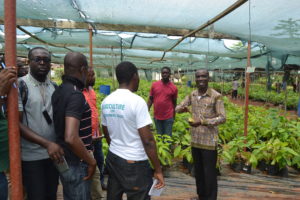
The Director of the Institute, Enoch Nsiah, made this known at Mabang in the Ahafo Ano North district of Ashanti when members of the Ghana Agriculture and Rural Development Journalists Association (GARDJA) visited the Centre to learn the progress of research works into cocoa.
The field trip is a sequel to a two-day training programme for GARDJA members on cocoa sustainability.
Mr. Nsiah, who is a Plant Breeder, noted that the 25-year megakarya research which is being carried out in four phases is being supported by both local and international development partners. These partners have sunk huge sums of money into the project, since the first two phases, as far back as 2006.
He said the 3rd phase which is expected to start this year and to last for four years, will cost about five million Ghana Cedis.
The research, he said, involves budding and grafting of cocoa planting materials obtained from cocoa farms in the country and that the project is one of the few of its kind in the world.
He indicated that another subsidiary of the Cocoa Research Institute of the Council for Scientific and Industrial Research is also working on water use efficiency cocoa varieties that can withstand the worsening harsh environmental conditions caused by erratic climatic conditions.
He said for instance, that at Mabang, the COCOBOD has initiated steps sink more boreholes to aid the research project in view of the irregular rainfall pattern in the area.
According to Mr. Nsiah, even though cocoa requires an average of one thousand 600 millimeters per annum to do well, the area has been experiencing around one thousand 200 millimeters’ in recent times hence the boreholes to supplement the natural rainfall.